Autonomous exploration of unknown 3D environments
PhD work on the planning side of robotic exploration, from safe and sparse navigation roadmaps to exploration strategies deployed on a ground robot.
- Role
- CIFRE PhD candidate
- Organisation
- Inria Rennes × Groupe Créative
- Period
- 2021 – 2025
Problem
Exploration means maximising the information gained about an unknown environment, usually while limiting the energy spent doing it. Past sensor observations and future actions are tightly coupled: what the robot has already seen dictates where it should go next. The coupling is even stronger with directional sensors such as cameras, whose observations depend heavily on the robot’s pose.
Approach
Standard mapping algorithms provide the geometric representation of the environment. The core of the work exploits that map to derive navigation roadmaps and exploration strategies that respect the safety requirements imposed by the environment, while still producing high-quality observations with directional sensors.
Disk-Graph Probabilistic Roadmap
A sampling-based planner whose nodes are free-space bubbles. A biased sampling function expands the graph towards known free space and frontiers, giving an RRT-like exploratory behaviour while keeping the connectivity and flexibility of a graph.
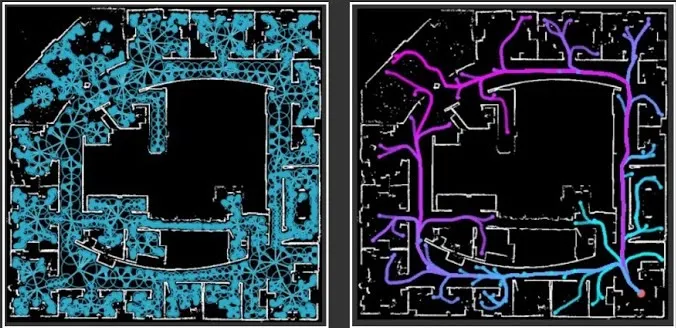
Skeleton Disk-Graph Roadmap
A deterministic roadmap built from the Hamilton-Jacobi skeleton of the free space. The skeleton is compressed into a sparse graph of free-space bubbles that keeps its topology, and the bubbles enforce safety directly in the roadmap structure. A frontier-based exploration strategy built on top of it autonomously and safely maps complete 2D environments.
Try it below: the roadmap is rebuilt in your browser from the occupancy map. Click to move the goal (drag the S marker to move the start), or draw and erase walls to see the skeleton and the bubbles adapt.
Loading…
Results
The methods were evaluated extensively in realistic simulation environments, then deployed on a ground mobile robot with various range sensors in multiple real-world indoor experiments. The full work is described in the PhD manuscript, defended in January 2025.
The project also covered the engineering around the algorithms:
- a custom Unity-based simulation environment;
- the design, manufacturing and integration of a two-degrees-of-freedom (pan-tilt) camera mount, used for targeted information acquisition during exploration;
- integration of the sensors and on-board processing on the wheeled robot.