Self-collision avoidance for the SOLO quadruped
Lightweight, smooth self-collision models combining geometric primitives and learned distances, running in an on-board safety controller.
- Role
- MSc research intern, Gepetto team
- Organisation
- LAAS-CNRS
- Period
- 2020
Problem
Self-collision detection and avoidance are essential for reactive control of dynamic robots with legs or arms. Few control methods handle these constraints directly, so collision-free trajectories are often left to a planner upstream of the controller.
Approach
Two lightweight, conservative and smooth models are combined to handle self-collisions generically:
- Distant body pairs (e.g. segments of distinct legs): forward kinematics on simplified geometries, with analytical derivatives.
- Body pairs moving close to one another: a learned approximation of the collision distance in joint space.
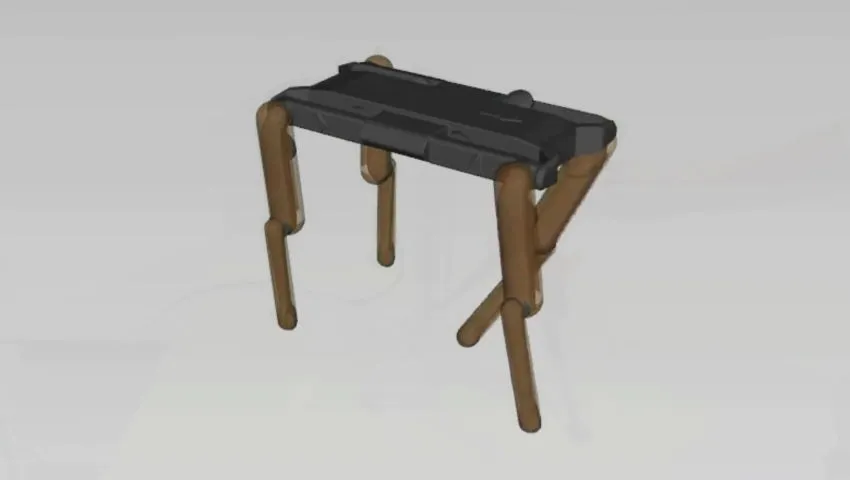
The demo below reduces the problem to the first case: the front and hind left legs of SOLO, seen from the side as two 2-DoF planar chains of capsules. The distance between each pair of segments from distinct legs and its gradient with respect to the joints are computed analytically. Below an activation distance , a repulsive spring–damper on each pair distance is mapped to joint torques, , and added to the joint PD controller tracking the reference. Toggle the safety controller to see the reference motion drive the legs through each other. For simplicity, each joint is simulated as an independent damped inertia, without gravity.
Results
The models were integrated in an on-board safety controller, deployed in real time on the SOLO 12 robot, and published at ICRA 2021.